

"Sometimes I wish the lense check was back."
Nina Kronjäger, actress, producer.
Nina Kronjäger, born in Marburg, lives in Berlin, mother of adult twins, co-owner of a dog.
Following a classical acting training in Munich, she was drawn to experimental theatre and moved to Berlin, where she worked with René Pollesch, andcompany&Co. and Amina Gusner at the Podewil, the Volksbühne Berlin, the HAU and the Theater unterm Dach. She has appeared and continues to appear in various cinema and television productions, including ABGESCHMINKT, TYPISCH MANN, OSTWIND and DARK. Nina also works as a radio drama narrator, for example as an investigator in the Radio Tatort episode Verden an der Aller.
She co-produced the theatre-hybrid film WHEN MUMMY GOES TO WORK EARLY by Amina Gusner and, together with the collective Lachende Hyänen, the performance An der Grenze. Recently, she produced the play SCHLEIFEN, KNOTEN UND ZÖPFE with her own collective, Sliders, in collaboration with the youth theatre ensemble RomPlay in Hamburg.
Nina is a member of Pro Quote Film and a patron of karo e.V., an organisation that campaigns against human trafficking, forced prostitution and the sexual exploitation of children.
Nina Kronjäger's Website www.ninakronjaeger.com
Nina Kronjäger's Agent www.agenturvogel.de
Webseite of the Collektive Sliders www.sliders.one
Dear Nina, let’s start with your personal background. How did you grow up, and what drew you to acting?
When I was born, my parents were still studying in Marburg. A few years later, they set up their own nursery with some other students, because the strict regime in the local state nurseries didn’t sit well with my parents’ 1968-style outlook on life. It was at that nursery that I experienced my first taste of collective living. After my father finished his degree, the family moved to Mannheim, where my mother then continued her studies. She’d previously taken a break to earn money for the family. At primary school, I was the only child in my class with parents who were academics; everyone else came from working-class families. The direct, warm, often rough manner really shaped me. ‘Don’t beat about the bush’ was the motto in Mannheim. And at the age of eight, I became a latchkey child, so from then on I had plenty of responsibilities and chores. I moved to Munich when I was thirteen, and there, at around fifteen, I decided to become an actress. It seemed to me the best way to escape reality, as I had a tendency to daydream. This daydreaming was certainly healthy, as the world was arming itself at the time and the Third World War was a real danger. I acted in school plays and applied to three drama schools even before I’d finished my A-levels – I was accepted by the third and final one, the Otto Falckenberg School in Munich.
For some time now, the issue of balancing family and career has been receiving greater attention in the film and television industry too. When you became a mother of twins in 2003, in your mid-30s, that was probably not yet the case, and perhaps it was a greater personal challenge then than it is today?
In 2003, I performed in René Pollesch’s 24 STUNDEN SIND KEIN TAG at Berlin’s Volksbühne. The theatre had no problem with my pregnancy. Everything went well until I went into premature labour, at which point the remaining three performances were cancelled.
Before that, in my fifth month of pregnancy, I’d received a very attractive film offer – a guest role in *KÖRNER UND KÖTER*. I knew I wouldn’t be able to film for a while, so it provided some financial security. My bump was already getting bigger, so I confided in the director and the costume department, but I lied to the insurance company. The costume department deliberately chose an outfit for me that concealed my bump, and widened the trousers as production went on. After that, film productions were off the cards for me. Pregnant women simply aren’t insured.
You mean a sort of cancellation insurance, in case you can no longer carry on filming in the middle of production, or something happens to you whilst filming?
Exactly. Before a shoot, we actors are asked about our health – whether we take drugs, have heart problems, whether a shoot has ever been cancelled because of us, or whether we’re pregnant. In that case, an insurer would probably be reluctant to cover you, and the production would have to bear the costs themselves if you were unable to work.
Did you have to sign a declaration to the insurance company stating that you weren’t pregnant?
I can’t remember whether I deliberately lied like that. Yes, probably.
Is a question like that even permissible?
I’ve no idea.
Fortunately, everything turned out fine; you gave birth to two healthy children whilst continuing your theatre and film work, and you were now a single mum. And at the same time an actress who wanted to get back to work at some point. Were you able to make demands of production companies, or did you tend to keep quiet so as not to jeopardise your return to work?
More the former. I started filming again when the twins were five months old. As everyone now knew about the children and I was the lead actress, I was able to make quite a few requests: on the first production, SCHLAFSACK FÜR ZWEI, I was given a pumping tent on set, as well as the caravan, as we were filming a lot in the woods. And the children were brought to me at lunchtime by the nanny. My lunch break was extended to allow for this.
By how much?
By ten minutes.
Whenever possible, I was picked up from 8 am onwards so that I could still breastfeed at home in the mornings. On the second production – the sitcom TYPISCH MANN – things went one step further. The production team assured me of core working hours from 9 am to 6 pm; any work before 9 am or after 6 pm had to be agreed with me. As a mother of infants with four months of filming ahead of me, this was a fundamental condition for me to even begin filming.
However, these conditions were not set out in a contract by my agency at the time, because they were afraid the shoot would fall through. So, once filming had started, I had to enforce these demands with the help of a solicitor. Whilst filming in a studio, I had my own quiet room, and my nanny would regularly join me with the children at lunchtime.
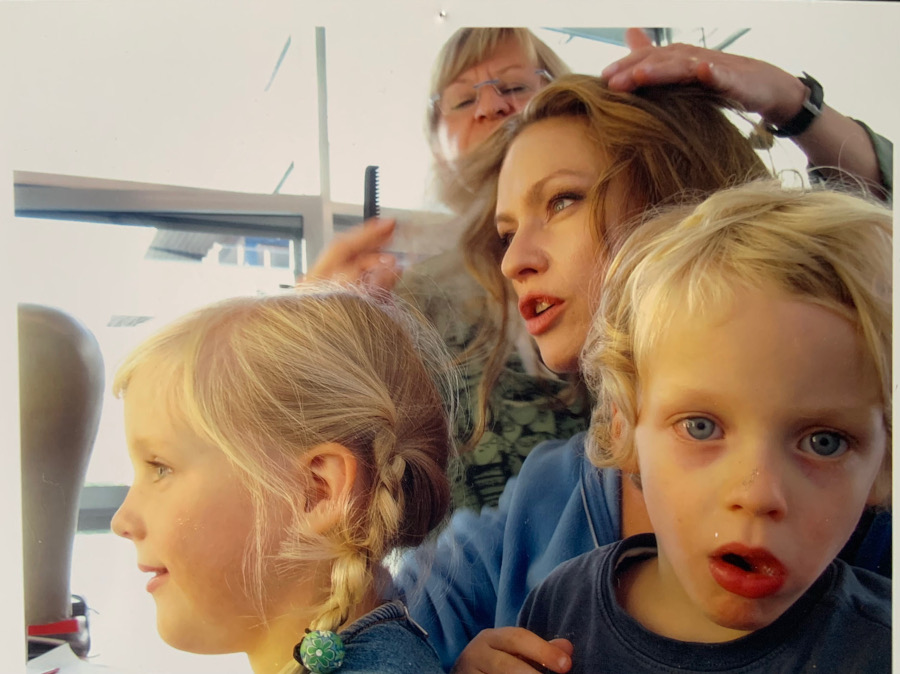
That sounds like good terms, even by today’s standards. I’m surprised at how accommodating the production teams were, because nobody is considered indispensable, not even leading ladies. How did you manage to secure such terms for yourself more than twenty years ago?
SCHLAFSACK FÜR ZWEI was another collaboration with director Zoltan Spirandelli and my colleague Jörg Schüttauf. We’d filmed EIN GANZER KERL FÜR MAMA in 2002 with this same team. The director was keen to have the same cast – so I was in a strong negotiating position. I filmed the sitcom with my ex and the children’s father, Thomas Heinze, as my co-star. In that case too, director Ulli Baumann and the production company Studio Hamburg seemed very keen for me to take on the role. So they were receptive to my arguments: I have two children, I’m still breastfeeding them, we need family time, and I can only manage this for four months if I have core working hours.
And what about support, for example from family members?
Thomas and I had already separated before the children were born. However, during their first year, he stayed over at my place two or three times a week so that I could have nights where I could sleep through the night. It wasn’t until they were two years old that the children started staying overnight at his place. But he supported me a great deal during the day. My mother also came from Munich to Berlin every now and then to help me. As well as the nanny, I had two babysitters. When they were two and a half, the children started at a nursery that I co-founded, as there were no nursery places available in my neighbourhood.
So you organised everything privately and there were no more demands or requests from the productions?
Yes, there were! With twins, I had to make demands right from the start. You can’t just ‘organise away’ two children – leaving them with a friend or handing them over to another nursery mum – as easily as you could have done with just one child.
From the time the children started daycare, I had au pairs for three years running. They, too, were fine with my hectic lifestyle and would sometimes come along with the children to the film set. Or they’d look after them when I was away from the city. I organised all the childcare myself. I sometimes negotiated with the production companies so that, during location shoots, they would contribute towards the cost of childcare accommodation or cover it entirely.
This became less frequent over time, as Thomas, the children’s father, took on more and more of the responsibility, and eventually they started school and could no longer travel with us so easily. We spent a lot of time poring over diaries. It was also difficult to plan because productions issue their shooting schedules very late – about three days before filming begins.
Our saviour was Jackie Brown, Thomas’s new partner. She was the only one of us who had a job in Berlin and was there all the time.
You hadn’t kept your situation a secret from the production team, and your colleagues both in front of and behind the camera will have noticed the twins on set. Do you know whether you were able to encourage other women in film or serve as a role model for them when it comes to negotiations?
It would be great if that were the case. But wasn’t I just incredibly privileged? Who else would have dared to make such demands as a script supervisor, prop master or make-up artist?
First and foremost, they are mothers, just like you. When they’re faced with the question of whether they can work at all, or only under certain conditions, the pressure is immense to make demands, big or small.
I get the impression that in a great many cases, the mothers of the film-makers or other family members took on the childcare – and certainly the partners as well. I’ve never experienced children on set amidst various crew departments.
And what’s the situation like today? Do you talk specifically with younger fellow actresses about starting a family and the challenges – but also the opportunities – on set, drawing on your own experiences?
As far as I know, pregnant actresses are still not covered by insurance – which is absurd. Pregnancy is pregnancy, not an illness. But I hardly ever see pregnant women on set.
We all talk constantly and at great length about our family situations, and I’m particularly pleased that it’s already becoming more the norm for younger women across all trades to share care responsibilities with a partner. But there’s another obstacle: due to stagnating wages and the insane rise in the cost of living, young fellow actors are thinking very carefully about whether they can afford to have children.
Were you able – or are you able – to use your position to advocate for female colleagues with young children?
It never occurred to anyone to bring children along as a matter of course or, for example, to ask to leave at 4 pm to pick them up from childcare. Childcare was a private matter. So I couldn’t advocate on their behalf.
Would you say that the attitude of the industry, or of film productions in particular, has fundamentally changed since 2003? Is the issue at least more prominent now?
Family is an immediate topic of conversation on every set. Women talk very openly amongst themselves about what it’s like to juggle children or caring for relatives with their careers. Most women don’t feel they receive enough support from the production team, unless they have a particularly family-friendly production management team. But they tend to be the exception.
As the lead actress, you can at least ensure on set that working hours are adhered to – the contractually guaranteed maximum working hours of 12 hours and filming breaks of 11 hours.
For you, or for the whole team?
If I’m in the final scene, it works for everyone. But that wouldn’t be enough to help a mother with a young child. Filming schedules are still too unpredictable.
What about the next generation?
I find that those in their early to mid-20s today are more open-minded. Among young filmmakers, there is perhaps greater awareness of the inequality that still exists between the different departments – directors bring their children onto set, but prop departments don’t – and fathers are increasingly wanting to spend time with their children too. But then the question is how these wishes can be accommodated in the day-to-day reality of the film industry, when more and more has to be filmed in ever shorter timeframes.
Sometimes I wish we could bring back the ‘lense check’. To explain this briefly: back when filming was done on film rather than digitally, every 3–4 takes had to be checked to see if a speck of lint had crept into the lens. During that time, the set would come to a standstill. Because if a speck of lint turned up, the lens would be cleaned and another take shot straight away. That slowed the day’s filming down a bit.
Or if there were more breastfeeding mums working on set, there’d be a pause for everyone.
Absolutely! In any case, family-friendly filming is one of the most important issues of all in our industry. And everyone would benefit from it, whether they have children or not, or have relatives who need care.
I, too, have at times had enough of long shooting schedules, travelling around and being away from home. The next generation is more aware of the need for a good work-life balance. If we don’t want to lose these people to other industries, we must fight for filming conditions that are people- and family-friendly. I can only hope that things will change soon. I’ve seen many colleagues who are unhappy, worn out and burnt out, whether or not they have dependants to look after. If I were a producer, I’d offer everything: a four-day week, job-sharing, and childcare on set.
Another important aspect is certainly the question of how many women are on set. If, for example, there are roughly equal numbers of women and men working on set, everyone treats one another more kindly and considerately than when only thirty per cent are women.
You attended the Pro Quote Film Congress in 2023 and subsequently became involved in the ‘Family-Friendly Filming’ working group. Why are you committed to this issue, and what do you hope to achieve?
I’m committed to this because I want to raise awareness and visibility of the issue. We filmmakers have all come to accept that filming is family-unfriendly and that everyone has to cope with it on their own. We can change that!
Ideally, just as with ‘Green Shooting’, there would one day be minimum standards for family-friendliness that all productions and all broadcasters must meet. And that, when it comes to funding, financial incentives for productions would be linked to whether they offer family-friendly standards. Presumably, there’s still a long way to go before that happens.
I’m pinning my hopes on two key factors: firstly, there’s a shortage of skilled workers – if we want to retain and attract them, we need to make significant concessions to accommodate them. Secondly, there aren’t enough children.
As a mother of grown-up children, how do calls for family-friendly filming affect you today?
My children are grown up now, and my son is living abroad. Nevertheless, as a mother, I’m still in charge, with a daughter at home and a son who comes home from time to time.
At the same time, I’m increasingly looking after my parents. My mum, who lives on her own, needs a bit of help here and there, and twice a year I take over respite care for my dad so that my stepmum, who looks after him, can go on holiday. And then there’s the dog. He goes back and forth between an ex-partner and me – logistically speaking, all of this is a challenge. It would be a great relief to me if film productions could take my family commitments into account. At the moment, looking after one’s family simply isn’t a priority in the film industry.
I no longer play leading roles, and as a supporting actress I can’t make any demands. So I accept that I won’t be able to film when I’m looking after my parents.
Caring for sick or elderly relatives of film-makers is rarely discussed in public. Could this be because, once again, this responsibility falls predominantly to women, who either do not speak about it or quietly leave the industry for a while?
That is certainly the case. There is still not enough public awareness that this work is important to society. And that it would be fair to share this work. I myself don’t yet publicise my caregiving responsibilities enough. I accept that it makes things financially more difficult, as no one compensates me for the time I’m off work. Health insurance providers don’t provide enough information either. This makes it all the more important to share information about advice centres and support services.
Suppose your children want to follow in your footsteps and go into the film industry too, and suppose they become parents themselves in ten years’ time – what will family-friendly filming look like by then?
I’d be delighted if the next generation of filmmakers had an easier time of it. It’s a source of motivation for me to be able to help improve the structures. Then there’ll be more time for creativity!
Thank you very much for the interview, dear Nina, and all the best!
------------------------------------------
Portrait photo at the start: Nils Schwarz