

"Anyone who can manage that with a baby can do anything!"
Vanessa Donelly, musician, composer, music producer.
Vanessa Donelly, born in 1992 in Gifhorn, studied music at the HMTM Hannover, specializing in piano, violin, voice, and orchestral conducting.
2017: Founding of Donelly Records recording studio.
Her professional credits as a composer include the ARD series *AM PASS* (Seasons 3–5), the TV movie *LOUMA* (ARD 2025), *SOKO LEIPZIG* (ZDF), the feature film *HYGGE* (premiered at the Max Ophüls Festival in 2026), and the video game *GHOST HAUNTING* by Three-Headed Monkey Films, for which she also produced the music. Vanessa’s musical 1000 TALES (text by James Coleman) premiered in London’s West End in 2025, and DIE DREI MUSKETIERE premiered at the Luisenburg Festival in Wunsiedel.
Vanessa lives in Gifhorn with her husband René and their daughter Coco (7).
Vanessa Donelly's website https://www.donellymusic.com/
Vanessa Donelly's agent https://www.mx-in.com/
Vanessa Donelly at Crew United https://www.crew-united.com/de/
HYGGE the Film https://klinkerfilm.com/hygge/
Dear Vanessa, let’s start with your family background. Do you have any siblings?
Yes, I have a brother who I grew up with, at least partly. But he also spent a great deal of time with my grandmother—they had a special bond. My parents own a construction company, so I grew up on the construction site.
The construction site as an alternative form of daycare?
Something like that. As a teenager, though, I knew that the construction industry wasn’t for me and that I wanted to compose film scores.
Did you learn to play an instrument as a child?
Yes. My parents are ethnic German immigrants from Poland. My mother had actually planned to attend a music conservatory back in Poland. But because she came to Germany when she was 14, that didn’t work out. And then she always said, “If I have a child who shows even a little interest in it, I’ll encourage them.” And that’s exactly what happened.
I had already been playing the piano since I was four and took lessons twice a week from a very, very sweet Japanese woman—she was absolutely wonderful. And the funny thing is that my daughter is now taking lessons from her, too. Sometimes I get real déjà vu moments. So Nobuko Nagaoka—that’s her name—tells her the same stories she used to tell me back then. She really enjoys talking to even the very youngest children about musical interpretation, which is why I was always pretty good at that. But what I hadn’t done well, for example—which is why my college studies were a total crash course for me, at least in the first year—was theory and ear training. I didn’t start studying those subjects until University—or rather, a year before University—especially ear training. And later in college, I even taught them myself, using a special solmization theory (“Solmization, a unique method that has been in use for centuries to teach knowledge of intervals and scales.” Source https://musikwissenschaften.de/)
So my mother encouraged me, but the thing was, I didn’t like giving concerts at all. It’s completely different from when I perform now with my band PASSIVATTRAKTIV, for example—a collaborative project among four friends—which is really, really fun. We play my compositions, the lyrics are by Rune, and my two friends, Lisa and Rafael, perform the whole thing. It’s very different from playing a concert alone at the piano or grand piano and just plowing through one Chopin etude after another. That’s what my teenage years were like—I played a lot of concerts back then. But I couldn’t regulate my emotions; I had real problems with that. Sure, I had some really wonderful concerts, but I also had a total blackout during one concert, for example, and then hid in the bathroom. It was totally… overwhelming for me, I’d say. My mother wanted that for me—she always wanted me to become a pianist—but I didn’t see myself in that role at all.
And then at some point I asked myself, “What do I actually want?” After all, I’ve always loved music—it’s been a very, very big part of my life. And at some point—I was about 13 or 14—it suddenly hit me: film music! It’s such an awesome job because, first of all, you get to work very closely with the visuals. There’s a lot of intense teamwork involved, which is super important because I love working in a team! But I also love working on my own, and that back-and-forth dynamic, which is a big part of film music. And I also love that once it’s finished, we can enjoy it together without me having to stand up front on stage and perform in that moment—instead, everything happens beforehand. Even when people come to my studio, we can keep working on it until it’s really perfect, until it’s exactly the version I have in my head. Or maybe they’ll suggest something that opens up new possibilities. You know what I mean? That patience and that time to savor it in the recording studio—that gives me so much. And the fact that you can then edit it again and really get it from your head into the DAW—which is software (laughs).
But back to your studies in Hanover...
Well, I studied piano, violin, voice, choir, and orchestral conducting there. Piano was my major, and at first, violin and voice were my minors.
When I was preparing for the entrance exam, I learned that you had to play three instruments, and I thought it would be really great to start with the violin—I’d always been interested in it anyway. But no, don’t do that! I mean, starting the violin just one year before the entrance exam. Let me put it this way: I had my final exam after two years, and I played “Schindler’s List”—and the way I played it, people practically died all over again; it was really, really bad. My violin professor then said, “Vanessa, you’re getting a grade B because you’re trying hard, but please never touch that instrument again!” (laughs)
And that’s exactly what I did—after two years, I was able to switch from the violin, and for the last two years, my major was choir and orchestra conducting, which I really thrived in, partly because I figured I’d need that for film music.
I didn’t have any further contact with the violin after that. I know now how it works, and that’s all well and good, but it’s just not my instrument.
And then you graduated and became a film composer.
We’re all familiar with film music, but we know less about what that work actually entails. Can you describe a project—from the initial commission to the film’s premiere—and how long it takes?
It actually varies a great deal. Let’s take a current project, DEUTSCHE VITA—I’m already involved in that one. They’re currently on what I think is the ninth draft of the screenplay, and I’ve received all of them. We’ve also had a music meeting, so I know what to expect—there might be a song that needs to be recorded before filming because there’s a karaoke scene in the movie. But even aside from that, I’m already involved in an advisory capacity before I even write a single note. And there’s a lot of discussion with the director. Well, in this case, Lena and I already know each other (from the HYGGE project). And we know what the other person is capable of. I’d say we trust each other in that regard. And we talk about the film; we brainstorm which songs might work well, even if those songs don’t end up being mine. I also serve in an advisory capacity regarding which other songs can be used and where the music—that is, the film score itself—begins, which is then my responsibility. And in this case, I’ll probably start with the fine-tuning or the picture look.
But I had just worked on another film, *ESTERTOR* (=Death Rattle), a Spanish film—they work completely differently—and Pablo (Pagan, the director) wanted to have the music ready for the shoot so he could play it there for the actress and so on. There was a lot of back-and-forth about what he actually wanted. Often, directors send me a whole list of songs: “This is roughly what we have in mind, and this kind of film music and so on.”
That’s always really exciting. For example, with ESTERTOR, which is all about death and destruction, we created totally surreal, dissonant sounds and experimented a lot with the instruments. With the TV movie LOUMA, it was completely different—we used six accordions and turned them into very, very lyrical and beautiful music.
That means it really all depends on what the director wants, or sometimes what the editorial team has in mind—the producer also has a big say in things. So there’s a very, very extensive brainstorming session beforehand. And then I try, so to speak, to find that middle ground from all these discussions—what people want, but also what works best for the film and what it needs. And I’m, in a sense, the living translation from words to music.
As the process continues, I first compose the music for a scene and send it to the director; then I get feedback—there are so, so many rounds of feedback. Often, the initial version isn’t the final one yet; a lot of changes are still made. But often, it clicks right away. Every project is different. There are people I work with who say, “We have no idea—just do whatever you think is best.” And then there are others with whom I could spend half an hour discussing every single note, because, for example, they’re musicians themselves or play guitar, piano, or whatever, and so they already have some idea of what’s going on. And then you work differently and talk differently, too. Yes, it’s really, really interesting.
And here’s something that really helps me: I always have interns by my side who handle organizational tasks or put together portfolios for presentations, and so on. And at the same time, while the interns help me, I help them get a foot in the door in the industry. My current intern, for example, is now composing the music for a game by another student who had worked on my game (GHOST HAUNTING). I put the two of them in touch. And we’re always talking about the music my intern is currently working on for that game—it’s just that kind of collaboration, the way it’s supposed to be.
How long does a project usually take you?
It always varies. I spent two years on the game GHOST HAUNTING, working on and producing it whenever I had a spare moment. (laughs) But then there are also some really, really hardcore projects, like AM PASS, for example, which was created in four days because everything had gone wrong and I basically had to salvage it a bit from another composer, then started from scratch and really pulled it off in four days, because the director had phoned me and – without actually panicking, but definitely in a state of despair – said, “Look, I need music. And yes, it has to be finished by Christmas.” well, not panicked, but definitely desperate – and said, “Look, I need music. And yes, it has to be finished by Christmas.” But as I’d gone to Italy during that time, I really only had four days. That’s not the norm, of course. No, it’s not the norm! Normally, I have a few weeks to work on a film – about six weeks. But that’s not really true anymore, because these days people tend to ask me earlier, before the visual style has even been established. That’s actually very, very nice, because it means you feel more connected to the team again, and so on.
Oh Belinde, I’m telling you, it really is an incredibly wonderful job! I have the best job in the world – it’s a bit of everything, and it’s just absolutely brilliant!
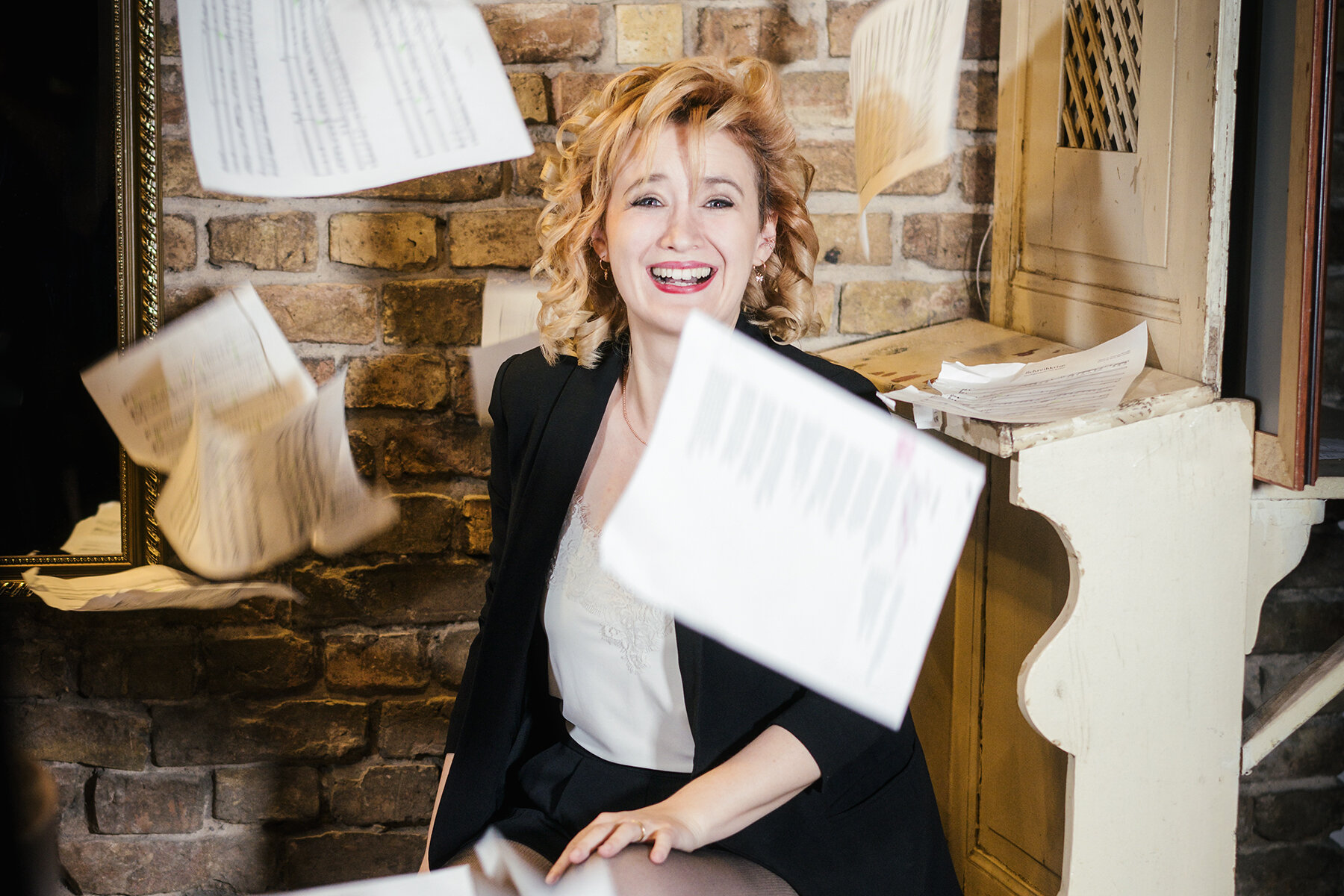
Vanessa Donelly. Photo by Oliver Betke
Your daughter was born in 2019. Did that change much for you professionally?
I think that’s when it all started, a bit. Coco was born half a year before the pandemic. And I made my first feature film three months later.
I didn’t tell anyone around me that I was having a baby because I was worried I wouldn’t get any new work. Today I might decide differently, but I’m not entirely sure. Anyway, it was thanks to my daughter that I got my agent: he rang me and said, ‘Send me your stuff – anyone who can manage that with a baby can do anything!’
So you carried on working as before, just with a baby in her cot next to you?
Something like that. As I work from home a lot, I had to create my own workspace there too. I’ve got loads of exposed beams in the studio, and back then my husband attached a spring rocker to one of them, and I sat on one of those exercise balls I had at the time so I could move about a bit. Either I’d have her in the baby carrier and bounce around on that ball whilst recording the tracks. Or she’d be in the spring rocker and I’d rock her with my left hand the whole time. And with my right hand, I’d be working on the computer or recording things.
And all that with a baby who doesn’t sleep through the night yet and gets hungry every few hours?
Yes. But I was still quite young, so getting up in the middle of the night didn’t really bother me much. I was always awake roughly every two or three hours, and later on, it settled at three-hour intervals fairly consistently. That’s actually how we organised our daily routine once we’d settled into a consistent three-hour pattern. So we breastfed at twelve, three, six, nine and so on, round the clock – we had fixed times. I took plenty of time for breastfeeding; each feed took a good 15 minutes per side. We took our time with everything.
And so our daughter has actually remained to this day a very slow, unhurried person, very, very thoughtful, and even a bit of a perfectionist, actually.
But let’s get back to your work as a film composer.
Yes, well, a typical day back then involved me getting up every three hours during the night. And what I found very reassuring was that she didn’t really cry out at night. Only right at the very, very beginning. But she’d sort of wake up with little noises, and I’d already know, ‘OK, she’s about to wake up and then she’ll start crying.’ It’s that – I don’t know if you’d call it a mother’s instinct, because ultimately any father can develop a sort of father’s instinct too, depending on how much he’s involved. Ever since I gave birth to Coco, I’ve been a very, very light sleeper. No matter if there’s just a faint ticking or ticking sound somewhere, I wake up straight away. And I do the same with her soft ‘woe-woe’ sounds. The baby wasn’t even properly awake yet. I went to the loo first, then picked her up and put her to the breast. And she’d feed whilst half-asleep, and that happened every three hours. Then at some point we’d be awake, around six or nine. And I’d start work after the 9.00 am feed. And when my husband was working too, I’d have her next to me in the cradle. But he was off work for the first three months – no, the first two months. Or was it three months? I can’t quite remember now. Then, for example, he’d often take her for a walk and things like that; we didn’t have an au pair yet.
Let's talk more about the au pair program—it's an option that's rarely suggested in lists for balancing film and family.
Sure, I'd love to! Well, the idea of an au pair only came up when Coco was two and a half. By then, I’d already started at the school in London, BML – Books Music and Lyrics – which is an educational institution that runs a sort of evening university, specifically for people who are also working, who’ve already got one foot in the industry, so to speak. And at BML, it’s all about musicals. That was never really my goal, even though I’m writing musicals now. But I sort of slipped into it because, deep down, I absolutely love musicals. And I think musicals can do so much more than just ‘Heidschi Bumbeidschi’ on stage. You really, really notice in London that it’s a means of offering social criticism, of simply getting political. It’s on a different scale in London than here in Germany (laughs), but that could still change. And I also know that there are now lots of musicals on the rise that operate on multiple levels.
And just as I’d got started in London, the thought struck me for the first time: ‘Right, this is going to be quite a lot to handle’. We mustn’t forget that our society, our system, is designed on the assumption that both parents should work – or want to, of course. But at the same time, there are still these rigid structures, meaning that ultimately you’re dependent on third parties, even if it’s just a nursery. But a nursery isn’t flexible, so at some point you end up relying on grandparents, an aunt or a neighbour. And unfortunately, for family reasons, we couldn’t do that – primarily because of my mother’s poor health. That’s when we reached a breaking point. My mum is a lovely person, the sweetest person in the world that I know, and she’d do anything for her children. And I think it’s also our job as children to recognise and understand this, and to sense when it’s our turn to step in and say, ‘You can have endless fun with the child, but when it comes to these tasks, you don’t need to do them.’ Because that’s something that really drains her energy, or if, for example, the child wants to stay over at her place for a day or two, she reaches her limits but doesn’t show it. And I don’t want that; she should simply enjoy the lovely time with Coco for as long as she can, for as long as she has the energy for it, and really just do lovely things with her, because they both love each other very much.
But I do need someone at home, as my backup, by my side. And my husband does work a lot. I work a lot too. We were in Italy at the time, staying with my friends, the ones I’d made my first – Italian – films with. Their names are Silvia and Peter Zeitinger; I learnt so much from them. About film and about life – what it actually means and what we should reflect on, what’s really important to us.
Anyway, at one point Silvia said, ‘Why don’t you get an au pair?’ And my first reaction was: ‘Oh my God, no, I’d never do that. It’s just a complete stranger living in my house.’ But then the idea really sank in, and I started thinking a bit more about what it actually meant. And in the end, it was the best thing that could have happened to us. We’ve had five au pairs so far, and the sixth is coming in September. And yes, of course – I have to admit – we’ve also had two au pairs who weren’t quite right for us. We sent them home early. But all the other girls who’ve been with us have been brilliant! We’ve developed such a close, friendly bond – with two of them, it’s almost like a sisterly relationship. Nobody can take that away from me now. And we’ve always said that when Coco turns 18, we’ll give her a bit of money and she’ll go on a round-the-world trip to visit her au pairs.
We’ve already had au pairs from Canada, the US and Madagascar. And the next one to arrive is from Canada again, because we’ve realised that every au pair is different – no question about it – but we feel that, in terms of our mindset, we get on best with the Canadians. And what’s happened at the same time is that, after all, the girls aren’t just there to be childminders and then basically stand by our side – that’s not what it’s about at all – but they’re really integrated into our lives, and that brings so much enrichment.
Another good thing about this is that Coco won’t have to deal with nannies or childcare providers changing every time there’s a new production or for any other reason.
Yes, that’s true. In our case, I sometimes just brought the au pairs along with me — especially in the beginning. For example, I drove to Munich, stood outside the meeting room with the baby and the au pair, and said, “Go for a two-hour walk, and then come pick me up.” Otherwise, this is definitely a great model, especially for a composer or author who works a lot alone and at home. For on-set professions, you’d have to think it through again to see when it makes sense and when it doesn’t. The nice thing about an au pair is that you have someone by your side who sticks around. It’s always the same girl, whom—in the best-case scenario—you come to trust after a few weeks; you get to know her.
And to some extent, we’re letting new traditions into our home. It’s enriching; after a while, your own little world gets just a little bit bigger. But without wanting to romanticize it, it can also be exhausting, especially if the girl doesn’t fit in with the family.
How do you find your au pairs?
We use an app called https://www.aupair.com/, a bit like a daiting app, only it's about finding an au pair or a guest family.
Can you say something about the costs?
An au pair needs their own room and receives €280 in pocket money. On top of that, there’s an average of €500 to €600 extra per month, as there’s one more person in the house who eats, showers, has their own needs and usually takes part in family activities. And just under €30 for the au pair’s health and other insurance.
I’d always wanted to have three children, but it didn’t work out. I think Coco will remain our only child, because she was actually our fourth attempt at IVF, and that loss of a child I’d experienced before – I wouldn’t wish that on any woman, and no one should have to go through it. But I know that many, many women go through this, which is why it’s important that we talk about it. Still, it really is tough. We took a big risk and invested a lot of money to have this child. And in the end, she’s here. She’s healthy, she’s wonderful, she’s clever, she’s pretty. So why take that risk again?
And having au pairs brings a bit more life into the house, which I love. And at the same time, Coco has learnt English. At the moment, 50 per cent English and 50 per cent German are spoken in our house. And I just know what that means, because I myself grew up bilingual with my parents. I also had my own ‘Babcia’ back then – that’s what I always called her. She wasn’t actually my ‘Babcia’ – that is, my granny – but an elderly woman from Poland who only spoke Polish and looked after us children when my parents were out and about. They were away a lot because of their jobs. I think I’ve picked that up a bit from them. They were self-employed, after all. And it’s given me a lot, actually, to be bilingual like this.
Is Coco learning Polish too – from you or from her grandparents?
No, unfortunately not. By the way, René’s parents are both German; the surname Franziszczak had more or less fallen by the wayside.
Polish lullabies, perhaps?
No, unfortunately not that either.
That might still happen!
But let’s finish by briefly discussing specific measures for family-friendly filming. Would it be possible for film composers to work part-time or in shared roles?
Part-time in the sense of intensive phases working on a film project and more relaxed phases without one – yes. During post-production, definitely not.
Job-sharing is possible. The setup just needs to be well prepared: the same DAWs (= Digital Audio Workstation = software), perhaps even a shared cloud with plugins and libraries that both composers can access. Teamwork in film music is nothing new and is becoming increasingly common.
How can female film composers maintain their connection to the film industry during a prolonged absence due to family leave? Who should be involved – a professional association, a production company?
That’s a very good question, but I can’t answer it for myself – I had my daughter just before the pandemic.
But of course we have the DEFKOM (German Film Composers’ Union), of which I’m also a member, and the Composers Club (Professional Association of Commissioned Composers in Germany) and so on, where composers can exchange ideas.
But otherwise, if you’re away for a longer period – for example, as was the case with my pregnancy, which was absolutely dreadful with contractions from the 20th week onwards, and so on – I think you have to be brave enough to simply take that time out. But it’s still possible to stay in touch. Sooner or later, I end up becoming friends with a great many of the people I work with. Not with everyone, but there are certainly one, two or three handfuls of people I can still message on a Saturday evening or arrange to meet up with. But I don’t think it’s such a bad thing to simply step back for a few weeks and then be there again. And there are loads of opportunities for that, too.
Today I received another email from WIFT (Women in Film and Television) listing events. I’ve also been to WIFT meetings in Munich with Constantin Film from time to time – that was really lovely. And there are lots of other opportunities, such as composers’ meet-ups, or mixed gatherings involving all sorts of different trades. There are also plenty of different parties and events at the Berlinale. You just have to pick out the things where you think, ‘OK, that’s where I belong; that’s where I can show a bit of who I am.’
For the first two years of the Berlinale, I went to this Crew Call (organised by Crew United) on the eve of the festival. And at some point I stopped going because I thought, ‘Oh my goodness, it’s just one massive party – it’s brilliant, and I’ve met some great people there too. But you’re just shouting the whole time. You come out at two or three in the morning and lose your voice completely for the next five days.’ I have to say, that’s not really my thing anymore.
There are also other people for whom it tends to drain their energy. But it really is a profession that brings people together, one that’s very, very people-oriented. Because ultimately, the music only comes about through collaboration with the team. On my own, I would have written completely different music; working with others, it becomes 100 per cent something completely different. And that’s what makes this profession so interesting, and the whole experience of working together so wonderful. Celebrating premieres and things like that are a huge part of this long-term job. It’s a part I always look forward to.
What would help you personally not to lose touch with your family entirely when you’re working full-time as normal?
That’s a very difficult question. Precisely because you’re so deeply immersed in an artistic process and pour all your energy into it. Of course, it helps if your family is understanding, but the time commitment is nonetheless a strain. I’m lucky enough to be able to work from home and am physically there, though my mind is elsewhere. I’d like to be able to do that without feeling guilty. But that’s something that needs to develop and be passed on over generations. It’s a matter of equality and appreciation, particularly when it comes to music.
Just to give an example: the child is ill and needs to be picked up from the nursery. The mother comes – that goes without saying. The father comes, and he’s the hero of the day. People might even ask him, ‘Where’s the mother? Wasn’t it important enough to her?’ So she’s a bad mother.
In spring 2024, you were invited to speak to the German Bundestag’s Culture Committee about balancing family and work in the arts and culture sector.
Yes, the invitation came about through Anikó Glogowski-Merten, who was responsible for culture in Braunschweig and also served in the Bundestag. She had invited me to the Bundestag’s Culture Committee (see also: ‘The difficulties faced by creative professionals with families’ on bundestag.de). I gave a speech about how I’d come to work with my agent and what it actually means in society to be self-employed and have a child, and how this is often viewed rather negatively.
And that had a huge, huge impact; for example, the following year I was able to open Soundtrack Cologne with the same theme. That’s how I got to know my production company and also my director, Tali Barde, from Three Headed Monkey Studios, with whom I made the game GHOST HAUNTING. This also led to lots of panel appearances where I was able to speak on the subject. And yet it was clear to me: yes, I definitely want to talk about this, but I don’t just want to be the ‘mum on duty’. I want to be invited to speak on other topics too, where I can inspire people. But of course, I think work-life balance is a topic we should be talking about much, much, much, much more.
Society, particularly the next generation of parents, needs role models. How is the issue of work-life balance portrayed in films and TV series?
Well, I think the best example of this is actually *LOUMA*, the film I finished this year. It’s called *LOUMA – FAMILY IS NO CHILD’S PLAY*, and it’s about a mother who dies, leaving behind four children by two different men. And these two men move in together so that the children aren’t torn apart. And this is explored so beautifully, because, of course, on the one hand they’re also dealing with their grief and so sometimes neglect the care work, even though they don’t want to and are really, really doing their best. I think it does a really good job of exploring what it means for men – or even for two men living under the same roof – to take on care work. And especially with such difficult issues, where you might actually wish you had a mother by your side, things are perhaps a bit different after all. But all families are different; there’s everything from blended families to all sorts of other set-ups, and everyone finds their own way.
Vanessa, we did it – that was the last question!
Although, there’s one thing I’m still curious about: your website is only in English, you did part of your training in London, and you have a surname that sounds English. What’s the connection?
Yes, that’s funny! As you’ve already learnt, both my parents are from Poland and my surname used to be Gajda, and my husband’s was Franziszczak – so Franzi and then s-z-c-z-a-k. But then I said, ‘I’ll never in a million years, never in a million years take your surname,’ because I already knew back then – we’d met when we were 17 – that I wanted to appear in the credits one day, and I certainly couldn’t be called Franziszslczsczkrrczkrr. And I found that whole idea behind it very funny. Because it really annoyed him. Whenever he was in the office or at work or whatever, he was always René. So never Mr Franziszczak, but always either René or ‘Mr Franzi… well, you know’. Or they’d pronounce it completely wrong. And then at some point he changed his name.
If you have a name that’s very difficult to spell or pronounce, you’re allowed to have it changed. And he just wanted to have that long tail at the end trimmed off. But if you change your name, there can’t really be any new valid reason why you might have had to change it again. And then what was bound to happen happened. You can have a first name that you use as a surname changed back. And when they shortened that Franziszczak, it became Francis, Franzi, Franz, Fran. Well, and then all that was left was Fra. And now just imagine: Frau Fra? Exactly. And for that particular reason, he was effectively allowed to choose his own name.
We eventually settled on Donelly. It was a year-long back-and-forth process; we started with O’Melly or even completely different names. We just wanted it to sound quite international. And there was always something wrong – because of the apostrophe, or this, or that. It really was a lot of back and forth, and at some point they suggested Donnelly with two Ns. And then I said, ‘No, I don’t like that at all, because then I’d have to keep saying, “Yes, here with two Ns and there with two Ls and a Y.” No, that’s too much for me. But maybe Donelly would work, because Nelly’s a name people already know, so it’s somehow easier.’ And you can still put ‘Don’ in front of it. Donelly. It’s a very simple name, international, and you don’t come across it very often. And then, after a whole year, they approved it, and at first only my husband was called Donelly – René Donelly, that is. My in-laws didn’t like that at all, but what can you do? We had our own reasons, and we’d actually got married separately at first – keeping our own surnames – so I was simply Gajda. But I eventually took his surname a year after the wedding. So, Donelly.
I have to say, our relationship is very, very equal. You can see that just from the fact that, for example, after a wedding, it’s usually the woman who has to change all her documents… In our case, we both did, because we’ve both taken the new surname Donelly, and that was a lovely feeling. Right, let’s get our new little Donelly family off to a good start!