

“We didn’t want theatres to just tick a box – we want the process!”
Verena Usemann, Opera Singer, Bühnenmütter / Culture Care
Verena Usemann, born on 26 March 1981 in Hamburg, studied singing at the Felix Mendelssohn University of Music in Leipzig and at the University of Music and Performing Arts Vienna (mdw).
Career highlights include the tfn Theatre for Lower Saxony and the Coburg Regional Theatre, as well as collaborations with the LINOS Ensemble, the ensemble risonanze erranti and the Berlin Chamber Ensemble for New Music. She made her debut with the NDR Symphony Orchestra in MOSES AND ARON at the Elbphilharmonie in Hamburg in 2017.
Her operatic repertoire includes numerous lyric mezzo-soprano roles such as Rosina (THE BARBER OF SEVILLE), Varvara (KATYA KABANOVA), Romeo (I CAPULETI E I MONTECCHI), Melisande (PELLEAS ET MELISANDE), Orpheus (ORFEO ED EURIDICE), Octavian (DER ROSENKAVALIER) and the title role in Handel’s RINALDO.
Verena has been working as a freelance singer and vocal coach since 2018.
In 2021, she co-founded BÜHNENMÜTTER with a group of other female performing artists; she has been a member of the board since 2022 and has been employed by the organisation since December 2024 as co-project manager for the Culture Care project.
Verena lives in Berlin with her husband and their three children.
Verena Usemann’s agency https://helfrichtartists.com/Artist/verena-usemann/
Bühnenmütter* e.V. https://www.buehnenmuetter.de
Culture Care project https://culturecare-bm.de/
Today we’re not talking about the film family, but about the stage that means the world.
Dear Verena, thank you so much for taking the time to talk with us!
My pleasure.
Opera and concert singer— has that always been your dream? Or did you first want to be a pop singer and practice at home in front of the mirror with a hairbrush as a microphone?
No, it was quite different. I actually wanted to become a cellist! As a child, I learnt the cello and played it very intensively, and briefly dreamt of making it my career. Alongside that, I was in the children’s choir at the Hamburg State Opera, so I was involved with opera and the stage, which fascinated me greatly.
I was initially brought up in an orchestral environment, and started taking singing lessons relatively late, at the age of 16. My parents were friends with a singer who kept asking me: “Don’t you fancy giving it a go? I could really see you doing it! Let’s meet up sometime.” And then singing really gripped me, and I very quickly made it my thing.
When you’re seriously learning a string instrument, you practise for hours every day. It’s incredibly hard work and also involves developing motor skills through repetition. At some point, I got fed up with it. With singing, I found the way of practising so much more interesting, as it works through imagery. It was also more imaginative – like an experimental toolbox – and it felt different every day. It isn’t always easy, but this kind of practising inspired and motivated me. So I decided: if I’m going to do anything with music, it’ll be singing!
In the meantime, I’d started studying philosophy, because I used to think I’d definitely go into the humanities. But then the entrance exams for the conservatoires came around, and I thought, ‘That’s my dream; I’d really love to do that.’ And if it didn’t work out, I’d still have the humanities. So I was never solely focused on that one thing.
And then it all worked out!
And then it all worked out, yes. I studied in Leipzig and enjoyed every lesson and every single day! Especially after studying philosophy – sitting in the library, reading books, writing essays – I thought, ‘Wow, this is the real life!’ Then I went to Vienna for a short while because I had a brilliant teacher there. And I would also have had the opportunity to do postgraduate study leading to the opera concert exam. I could have carried on studying forever – I really enjoyed it. But at some point I wanted to find out whether I could actually earn a living in this profession, so I decided against further study and the exam after all.
I went back to Germany, did some auditions and I think I was also very lucky, because I got a permanent engagement very quickly and embarked on a career on stage. I saw that as a great privilege, because I never took it for granted or assumed it was the only path for me and that it would definitely work out.
That’s why it’s only natural that I’ve now moved away from singing as a means of making a living.
Does your partner work for the stage too?
Yes, we actually met at the theatre. Back then he was mainly an opera director, but then he moved more into acting, and now he works at a theatre for children and young people.
Going back to what you were just saying: instead of carrying on studying forever, at some point you’ve got to start earning a living...
Yes. And the real learning – you can’t really imagine that whilst you’re at university; it happens on stage, it's a different kind of learning. I actually left my first permanent engagement as an opera singer of my own accord after two years because I felt I wasn’t learning enough there anymore. I actually wanted to learn other things and develop more quickly or in a different way.
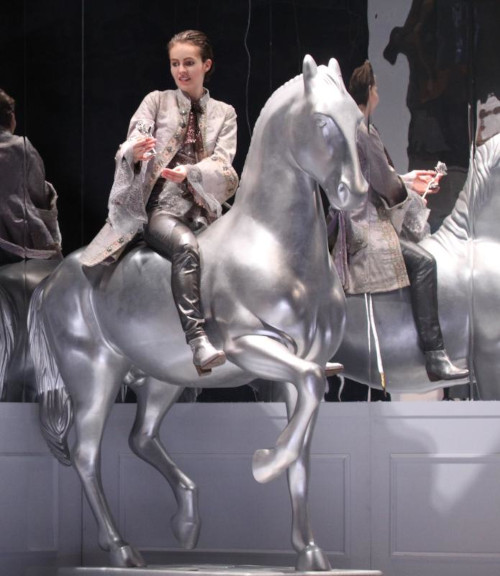
Verena Usemann as Octavian in DER ROSENKAVALIER, Coburg State Theatre
And then you had three children. And now you’re part of ‘Bühnenmütter’, an association for artists who’ve experienced just how difficult it is to balance a career in the arts with parenthood or family life. Because you’re not just focused on parents and young children, are you?
Absolutely. We now work much more with the concept of ‘care’, and advocate for everyone working in the arts and culture sector who also has care responsibilities. I think we’ve become much more open and inclusive, including in our membership: many aren’t mothers or parents – or aren’t yet – but are still engaged with the issue of care.
For example, looking after relatives.
Exactly. Our area has become increasingly broad, as has our target audience. We now have male members too. And we’re actively trying to move away from the image of being a ‘mums’ club’.
The Bundesverband Vereinigung (Federal Association for Work-Life Balance) has been around for some time now. I believe the word ‘children’ appears 200 times on their website. But there’s no mention at all of relatives in need of care – that area is ‘still to come’. Yes, but what does ‘still to come’ actually mean? You started out as Bühnenmütter (stage mothers), so naturally it made sense at first to talk about women with children.
Yes, that’s also drawn from our own personal experiences. But what’s also becoming apparent to us now in our Culture Care project is the feeling that the issue of care may well take centre stage in the coming years.
‘Bühnenmütter’: they aren’t just about musical theatre, but also drama.
Yes, our membership includes actors, visual artists, musicians, soloists, orchestral musicians, lead singers, authors…
So, basically everyone.
Yes, everyone. We’re also trying to set priorities through our digital conferences and specifically target other professional groups. Actors and singers may make up the majority, but it’s becoming increasingly diverse.
How many members do you currently have?
I think around 220.
Great.
And we now also have three theatres as members. We’d like to promote this further, because we’re currently spending a lot of time visiting theatre organisations, getting to grips with their structures, and are often invited to speak at staff meetings. There’s demand for this topic everywhere, and we’d like as many theatres as possible to become members and connect their staff with us. In return, we offer inspirational talks and training courses.
You have lots of members who work on a voluntary basis. And now you also have a few who are paid, for example, yourself.
That’s correct.
How many are there, and how did that come about? Surely these aren’t low pay jobs?
No. At the moment, we are ten powerful women on the board – a really great team, and all very committed to their roles on the board, still on a voluntary basis. In addition, there are many members who get involved on a project-by-project basis, for example by running workshops, speaking at events and representing us. And then, at the end of 2024, we struck gold: we applied for and were awarded an ESF grant – funding from the European Social Fund – for our Culture Care project.

This was a fairly logical development in our organisation’s history. We had, after all, been working for a long time on a catalogue of measures (Maßnahmenkatalog) titled ‘Recommendations for reconciling care responsibilities with artistic work in the theatre’. In it, we set out in concrete terms which measures we believed would make working conditions more care-friendly. We shared these proposals with the wider world and received a lot of positive feedback! Then the question arose: ‘This now needs to be put into practice. Who can do it?’
We would have preferred to do it ourselves. And whilst searching for funding, we came across the European Social Fund. I always say it was like catching a whale with a hand line! This type and level of funding simply didn’t exist in the cultural sector, where we’d usually been fishing. These are funds from the EU and the Federal Ministry of Labour and Social Affairs (BMAS) – and strictly speaking, it’s a further training grant that supports in-company training across entire sectors.
That was actually exactly what we wanted. We had very ambitious plans and sought advice from various sources, and we immediately got the feeling that the funding body thought it was brilliant. Although, as a small association, we did wonder: how can we possibly apply for millions here? Because the ESF tends not to accept applications for amounts under €800,000.
However, we received a great deal of support and encouragement there, and developed the Culture Care project in consultation with them. They were also enthusiastic because, as they told us, no one from the cultural sector had ever applied to them before to set up a structured further training programme. Nobody was aware of this funding either; it wasn’t something that had been publicised in the usual cultural newsletters.
And now everyone knows about it!
Just to clarify: ‘further education’ means that you are training theatres.
Exactly. And since you asked about paid staff: thanks to this funding, we now have permanent staff. In the first round of funding, there were six of us – two full-time and four part-time roles. Since September 2026, we’ve been receiving a further grant, so we’re bringing new theatres on board and, in a way, rolling out the process in the new federal states.
So, as of 1 September 2026, we have a total of eleven permanent staff members. That’s a huge leap forward for us! We now have an office, an art director, an accounts department and greater visibility – which, of course, also benefits the our association, the Bühnenmütter.
And we’re becoming more professional – or rather, we have to become more professional. We’re learning an absolute load simply by doing it. We still don’t have an office for the association, just our project office. But of course we can also do things for the association from there.
In February 2024, the advice and information portal ‘Familienfreundliches Drehen’ (ffd PQF - German only) went online – a resource that was somewhat wasted because nothing came of it.
You chose a different approach: rather than sending your action plan out as a mass email, you went to the theatres to speak to those in charge in person.
Exactly. We’d decided to channel our ‘women’s power’ into directly supporting these processes. That’s why we also scrapped our original ‘family seal’ idea, because we didn’t want the businesses to just tick boxes, tick off tasks and hang a gold plaque above the door – we want the process itself! And the process is a labour of love. You can’t just change a structure or a mindset overnight – not even in three years.
But we feel that all the discussions we’re having in the theatres are incredibly valuable – ‘Talking helps’ has become something of a catchphrase in our project! In the first year, we carried out a very detailed analysis of the current situation, conducted structured interviews in the theatres on the topic of ‘How is work-life balance practised here?’, and asked: ‘What ideas do you have? How do you perceive your managers’ attitude? What is the atmosphere amongst colleagues regarding this? What would you like to see?’
We spent a good hour talking to people in each of the theatres, which the interviewees really appreciated; that alone was an eye-opener and served as a form of awareness-raising in its own right. Afterwards, we fed the results back to the theatres and discussed them with the managing directors. From this, we devised individual measures for the theatres, which are now being implemented.
These are all small steps that emerge from constantly discussing and questioning the issues. Not to mention the structural changes we’re trying to put in place – agreements, childcare…
Have these “guided interviews” only taken place at the seven pilot theatres so far?
Exactly, as part of our analysis of the current situation. The interviews were an absolutely brilliant idea and, as well as providing insights, were great fun.
And we received feedback from the theatres that, through the interviews, we’d captured a great many fundamental issues and sentiments, and got to know the organisations very well. We also identified the interconnections: in which departments is work-life balance working well? Why is that the case? What’s the role of communication?
This, of course, is fundamental organisational development that we came across. We examined everything through our ‘stage mums’ perspective. We’re placed in a position of great trust because we come from the performing arts – in other words, we’re directly affected. We know the processes and the pain points; we know what a daily schedule looks like and how things change.
Have you ever encountered resistance from theatres? Or have you ever been told, ‘No, we’re not interested’?
Not really. Because we had to find partners very quickly as part of the application process, we initially turned to contacts where we felt the door would probably open easily. We were also recommended theatres that might be interested. So we didn’t do any cold calling.
Incidentally, theatres with female directors are significantly over-represented. I don’t think that’s a coincidence either.
Interesting. Why don’t you tell us your first seven model theatres?
Chamäleon Theatre, Berlin
Kampnagel, Hamburg
Theatre of Lower Saxony / Theater für Niedersachsen, Hildesheim
Theatre Aachen
Kassel State Theatre
Hanover State Theatre
Hamburg State Opera
For the new round of funding – where we had approached theatres in the eastern German states – it proved somewhat more difficult to generate enthusiasm and get institutions on board. I wonder whether there is a different mindset there regarding work-life balance, given the GDR’s past, where childcare was viewed in a completely different light. But that is just a vague conjecture.
Perhaps this hesitation had more to do with the general increase in pressure, and the fact that the theatres were concerned that such a process would consume too many resources. They’re already in survival mode as it is, and now they’re faced with a work-life balance process on top of that. But nobody is saying, “We don’t think it’s important at all; we couldn’t care less,” but rather, “We think it’s very important, but we don’t know how we can afford to get involved in such a process.”
Does the process cost the theatres money, or just time?
Time.
And that is the valuable bit.
Yes, of course.
Which theatres have joined since September?
Mecklenburg State Theatre, Schwerin
Neustrelitz/Neubrandenburg Theatre and Orchestra
German National Theatre, Weimar
Bühnen Halle
We have what we call ‘project coordinators’ in all the theatres. These are staff members on part-time secondment who work for us and with us for around two hours a week – that is, eight hours a month. This is absolutely essential to ensure we have regular dialogue and dedicated points of contact. And it has proved to be a great success. But, of course, these people need to be actually present in the theatre – not just on paper, but ideally in person, dedicating two hours of their working time to this.
Every week.
Yes, on average. Some of them do a lot more than that; they’re very committed and contribute their own ideas, so they also help shape this process.
We’ve designed a training programme for middle management. It’s called ‘caring leadership’. The model theatres get this virtually for free – a training programme funded through the project. It’s a bit like the work-life balance coaches in the private sector. These exist in some commercial enterprises, and they naturally have a budget to train them.
We’re also currently considering – we’re always thinking ahead and trying to get new funding and new projects off the ground – whether we can design a training programme for work-life balance agents, similar to that for sustainability managers.
Is all of this part of the Culture Care project?
Yes, at the 11 theatres involved so far.
And then other theatre directors hear about it and want all of that too.
Absolutely. That would, of course, be our plan: to develop this further and professionalise it during the current ESF funding period, and then perhaps offer it to other theatres on a modular basis after 2028 – by which time our funding will have been secured. But we need funding for this, because theatres can’t finance such a process themselves in the same way as commercial enterprises.
Can you say a bit more about your toolkit?
Yes, the Toolkit is aimed more at the independent theatre scene, and it’s really clear and comprehensive, like a little toolbox. Very inspiring!
Among other things, it also covered theatre visits for families.
Yes, the audience is, of course, also a target group for work-life balance initiatives. Performances can be staged at different times of the day, alongside a programme for children. This could take the form of childcare or a performance for children. It’s a broad field that we also touch upon in the margins of our project. There are one or two model theatres that are keen to consider the audience’s needs as well, which is brilliant for developing new offerings. Parents are a very difficult target group; they’re hard to attract as a theatre audience.
Just a quick glance at the film industry. There are quite a few people thinking about family-friendly film production, with lots of concrete ideas, suggestions and inspiring case studies. And there are regular panel discussions on the subject. All this has been going on for years. But not much progress is being made.
Why have you ‘theatre mums’ achieved so much already, and why are you able to work so effectively – whilst the ‘film mums’ haven’t, even though they want the same thing as you, namely to change mindsets and structures? What’s your secret?
We’re naturally very honoured to be perceived as so productive and visible – which, of course, we are. I can’t offer any profound wisdom here, but I can mention a few pointers:
Part of our tireless drive and energy probably stems from necessity. The problem is very real; we’re all very close to this dilemma, experiencing it either first-hand or through colleagues, and we feel a certain anger at the status quo or empathy for those who fail to cope with it – and that’s probably what spurs us on.
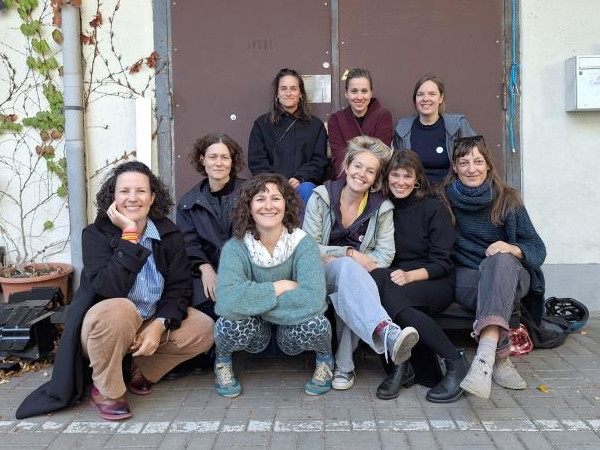
Verena Usemann, member of the Executive Committee of Bühnenmütter e.V., centre row, third from the right
Every member of our board has always been, and still is, a real force to be reckoned with in their own right. Positive energy and expertise come together, and that’s why this work – even though it’s largely voluntary – is such great fun. There’s no other way to explain why mums (!) who work in the arts and juggle their relationships or other family commitments sometimes spend their nights and weekends planning ‘Stage Mums’ workshops, writing grant applications or preparing for conferences. A sense of connection is what drives us, and all the gratitude and sense of purpose we constantly receive in return certainly helps, by the way.
Perhaps another small secret to our success is the stubborn consistency of our routine: we meet EVERY Tuesday morning and hold an online conference EVERY month. Right from the start. This consistency helps too.
And then – as far as the ESF is concerned – we were simply in the right place at the right time. We were very lucky there – which, of course, is another source of motivation…
Finally, back to you: would you like to return to the stage at some point, or are you happy in your role as an enabler and trailblazer for work-life balance?
I really can’t say. I’ve never made long-term plans in life. More often than not, doors open where things work out well. I’m currently in the job of my dreams. It’s challenging, but in terms of impact and purpose, it probably comes out better on balance than opera singing. Sometimes, when I’m singing in a concert, I do find myself wishing I could just make music again for a while, rather than sitting in video calls – and perhaps that will happen too. But right now, I’d much rather run the association’s office than take on a role at a theatre.